|
Dongguan Good World Museum
The exhibition area of the Museum consists of eighteen
areas. They are: Precious Furniture Area, Long Table & Plaque
Area, Decorative Products Area, Wood Carve, Stone
Carve & Brick Carve Area, Bed & Cabinet Area, Shrine Area,
Root Carve Area and Household Products of a Farming Village
House Area.
|
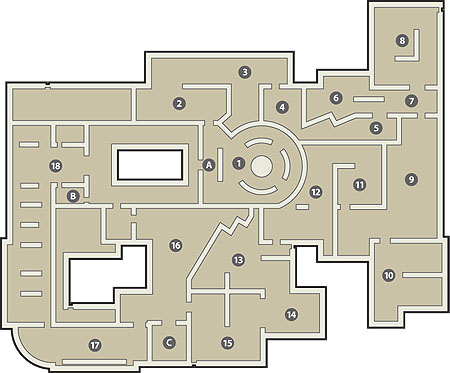
Floor Plan of Dongguan Good World Museum
|
|
|
Royal Furniture Area
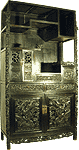 The Red Sandalwood and Huanghuali wood are very rare and worth.
The Red Sandalwood grows up very slowly. It needs hundred
of years to become a strong wood. It was found mostly in Vietnam
and India. It was also found in Guangdong, Guangxi and Yunnan
but in a few quantities. The Red Sandalwood is the most hard
and strongest compare with the other wood. Because the Red
Sandalwood is too expensive, the end products are less especially
the large in size products. Here, we show you one pair of
Display Cabinets is the result in high quality goods. The
Huanghuali wood is the lao Huali wood. Its' color is light
yellow, fresh and beautiful. Its pattern is clear. It is found
in Guangdong and Guangxi, but in a small amount. Mostly it
was imported from other country. The end products show you
a feeling of rustic elegance. Here, we show you one pair of
Huanghuali Round-corner Cabinets. You will find such special
feeling.
The Red Sandalwood and Huanghuali wood are very rare and worth.
The Red Sandalwood grows up very slowly. It needs hundred
of years to become a strong wood. It was found mostly in Vietnam
and India. It was also found in Guangdong, Guangxi and Yunnan
but in a few quantities. The Red Sandalwood is the most hard
and strongest compare with the other wood. Because the Red
Sandalwood is too expensive, the end products are less especially
the large in size products. Here, we show you one pair of
Display Cabinets is the result in high quality goods. The
Huanghuali wood is the lao Huali wood. Its' color is light
yellow, fresh and beautiful. Its pattern is clear. It is found
in Guangdong and Guangxi, but in a small amount. Mostly it
was imported from other country. The end products show you
a feeling of rustic elegance. Here, we show you one pair of
Huanghuali Round-corner Cabinets. You will find such special
feeling.
Long Table & Plaque Area
The long table
The long table has a pair of recessed-legs. There have two
types: one type the surface is even, and the other has two
up-turned ends. Mostly there has one board fixed between the
front leg and the hind leg. A base frame will be found in
some products. Here we show the product No. 60, Long Table
with Up-turned Ends. You will find the base frame fixed at
the bottom of the front and the hind legs.
Plaque
 In
ancient time, the plaque was used to eulogize the goodness
and the kindness of somebody. The plaques "Hóng Án
Níng Xiú - In
ancient time, the plaque was used to eulogize the goodness
and the kindness of somebody. The plaques "Hóng Án
Níng Xiú -  "
, "Shán Jú Póu Chéng - "
, "Shán Jú Póu Chéng -  "
that we show here, all are used to eulogize the goodness of
somebody. The plaques "Sóng Bái Cháng Qíng
- "
that we show here, all are used to eulogize the goodness of
somebody. The plaques "Sóng Bái Cháng Qíng
-  "
, "Xián Cí Dé Shóu - "
, "Xián Cí Dé Shóu -  "
, "Bí Yóng Dá Dié - "
, "Bí Yóng Dá Dié -  " and "Wú Huán Cí Wéi - " and "Wú Huán Cí Wéi -  "
all are used to congratulate the birthday of the eldest. All
are hanged on the dining room and let the guests see it clearly.
Nowadays, people use certificate, medal and honor to replace
the plaques. "
all are used to congratulate the birthday of the eldest. All
are hanged on the dining room and let the guests see it clearly.
Nowadays, people use certificate, medal and honor to replace
the plaques.
National China's Furniture Area
Ah! You look! This lamp looks the same with the lamp that
I saw before. When I was young, a similar lamp was placed
inside my parents' bedroom. Ah! You look! Here has a sewing
machine. It really looks like the one that my mother always
used in the past. The suitcase looks very similar to the one
that my grandfather used when he went to Hong Kong. Dear visitors,
how you feel? Do you have the same feeling? The younger visitors
will not have such feeling. The eldest will not feel strange.
Please come and enjoy the lovely past.
Stone Tablet, Brick Carving & Ceramic
Area
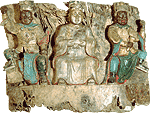 Wood
carve - Officers bodyguard Wood
carve - Officers bodyguard
This product is rare traditional style product. In the past,
people had a strong mind in worship the idols. They made the
idols of different type of materials. This product was made
of the root of camphor tree that had over a thousand years
old.
Stone carve - Hitching post
This product was made at Yuen Dynasty. An eagle stepped on
the shoulder of a man riding a lion and decorated with lingzhi
and flowers. In the past it was placed at the front door of
the official office and was used to hitch the horses.
Brick carve - Tile-ends
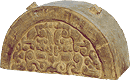 The tile-ends were one of the construction materials in ancient
China. It is a part of the tile. This part is to protect the
edge of the building from strong wind and rain. Except this,
it is another way for house decoration. It made the building
look grand and beautiful. The product, we show was made at
Warring States. At its surface carved the beast's face. It
is a rare and precious product.
The tile-ends were one of the construction materials in ancient
China. It is a part of the tile. This part is to protect the
edge of the building from strong wind and rain. Except this,
it is another way for house decoration. It made the building
look grand and beautiful. The product, we show was made at
Warring States. At its surface carved the beast's face. It
is a rare and precious product.
Bed & Cabinet Area
Bed has a very early history in China. Some one said that
the Legendary God of Farming invented the bed. Bed was not
only used when sleeping, it was also used as a chair in early
time. At Western Han the daybed was invented. It was a kind
of bed. It was only smaller and shorter in size when compare
with the Bed. Therefore Bed and Daybed have the same meaning
at that time. After the Han Dynasty, Bed and Daybed had a
clear definition. When the one was used in sleeping, it was
defined as Bed. And the one that was used by the guest during
the day for a rest was defined as Daybed.
Square Table & Shrine Area
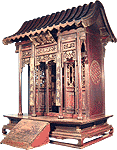 The
original name of the shrine is stupa. It is one of the earliest
Buddhism building in India. To memorize the Buddha, the saints
and the bonzes, the ancient Indian put their relics inside
the shrine. They respected and worshiped them. The ancient
shrine had a simple appearance. Then it became a grand building.
The construction of shrine was transmitted to China. Affected
by the Chinese construction, the shrine became smaller in
size. It could be placed inside the temple. People put Buddhist
idols or Buddhist relics inside the shrine. They worshiped
and respected throughout the year. The
original name of the shrine is stupa. It is one of the earliest
Buddhism building in India. To memorize the Buddha, the saints
and the bonzes, the ancient Indian put their relics inside
the shrine. They respected and worshiped them. The ancient
shrine had a simple appearance. Then it became a grand building.
The construction of shrine was transmitted to China. Affected
by the Chinese construction, the shrine became smaller in
size. It could be placed inside the temple. People put Buddhist
idols or Buddhist relics inside the shrine. They worshiped
and respected throughout the year.
Root Carving Area
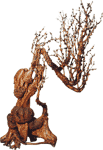 Root
carve is not only a skill. It is a skill including the nature
appearance. In all artwork creation, the particular set of
aesthetic principles of root carve is same as other artwork
creation. It also has a unique principle. The root carve will
maintain the nature appearance of the root. Just like the
man's skill mix with the nature's engineering. Here we show
you the root carves, for example: crocodile, parakeet and
plum blossom. All are maintained their nature appearances
of the roots. They look like real. Root
carve is not only a skill. It is a skill including the nature
appearance. In all artwork creation, the particular set of
aesthetic principles of root carve is same as other artwork
creation. It also has a unique principle. The root carve will
maintain the nature appearance of the root. Just like the
man's skill mix with the nature's engineering. Here we show
you the root carves, for example: crocodile, parakeet and
plum blossom. All are maintained their nature appearances
of the roots. They look like real.
Farm Tool Popular Science Area
Here we show you the decoration of a popular farming village
house. You will see what kind of the household products they
usually used and what kind of the products they used to decorate
their house. They have a simple and rustic life.
|






 Museum Entrance
 Toilets


